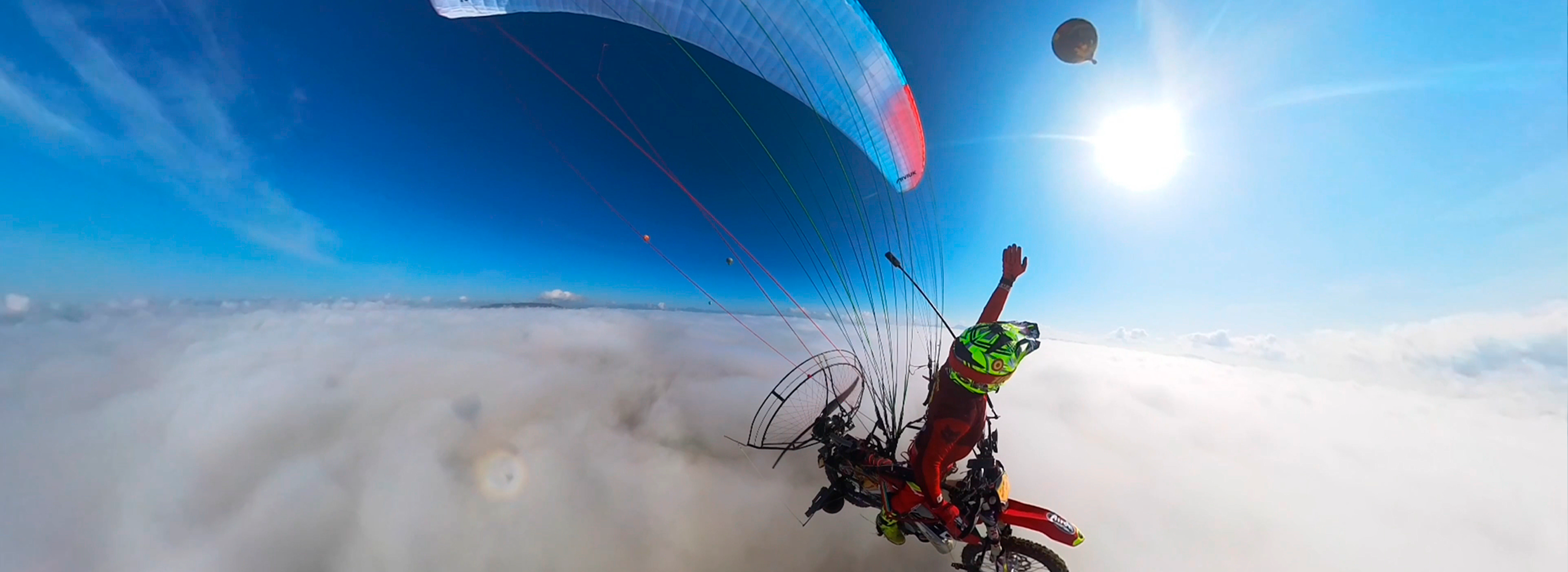
A motorbike flying by paramotor: the first freestyle motocross aerial show becomes a reality
Niviuk Adventure pilotJaume Bonet has achieved an unprecedented milestone in the world of aviation and motorsport: performing the first freestyle motocross in the air, taking off and flying with an enduro motorbike powered by a paramotor.
The project combines two highly demanding disciplines —paragliding and freestyle motocross— with a clear objective: to explore new forms of flight while always keeping safety as the top priority.
To make it possible, Jaume used the Niviuk R-Bus 2, size 40, a tandem paramotor wing certified to carry up to 600 kg in flight, a capacity that proved essential to the project’s development.
First live show: Bassella Race
The public debut took place at the Bassella Race, one of Europe’s most popular enduro events.
Jaume took off with the motorbike, crossed the finish line and flew over more than 1,200 participants and thousands of spectators, demonstrating that the concept was not merely experimental, but fully functional in a real-world environment.
Before this flight, however, there had been a long development process. Watch the interview where Jaume explains it:
https://niviuk.com/https://niviuk.com//legal/3
Months of testing: engineering, trial and perseverance
Before taking to the skies, there was an extensive period of experimentation. The first tests were carried out in his own workshop, using a crane, a tractor and a trial bike to simulate on the ground the manoeuvres he would later perform in the air.
Jaume Bonet personally designed a custom harness structure to connect pilot, motorbike and wing, precisely adjusting the length of the attachments, connection points, overall geometry and load balance in flight. His technical experience as a professional and commercial pilot was crucial in analysing every variable with an aeronautical mindset.
Much of the work was trial and error. He recorded the tests with 360° cameras from multiple angles to analyse every second of flight, make corrections and identify opportunities for improvement. “There are months of work that nobody will ever see. Many tests are discarded, but perseverance is what ultimately makes everything work,” Jaume explains.
https://niviuk.com/https://niviuk.com//legal/3
Why the R-Bus 2? Safety, margin and control
The combined weight of pilot and motorbike is around 180 kg in flight, a significant load, especially considering that many manoeuvres are performed at low altitude.
Initially, Jaume tested with a Takoo, but it was close to the weight limit. He needed greater operational margin, improved control and a more moderate speed. That is where the R-Bus 2 became the ideal tool.
“My main objective is always safety. That’s why I chose the R-Bus 2. I was surprised by how it handles and how easy it is to take off. I don’t have to worry about the flight, the wing works perfectly and I can focus on the bike.” Take-off behaviour proved to be one of the decisive factors. “I can take off even in zero wind. It’s like flying a heavy paratrike. The wing rises cleanly, in control, and helps me enormously.”
This ease of use allows Jaume to concentrate on aerial riding and executing manoeuvres without constantly managing the wing. Thanks to its certification up to 600 kg, the wing provides an enormous safety margin, responsiveness and stability — even in unconventional configurations such as this one.
https://niviuk.com/https://niviuk.com//legal/3
A production wing adapted to the project
One of the project’s most significant aspects is that the R-Bus 2 has not been structurally modified. The wing is entirely standard production. Niviuk’s engineering and design team analysed the configuration to ensure safety, aerodynamic efficiency and proper load distribution. The only adaptation was made to the risers, adjusting them to the specific geometry: “The wing itself has not been altered. We have only slightly lengthened the risers and added an optimised attachment point to improve the flying position and allow the manoeuvres to be performed more efficiently and comfortably, while maintaining the safety margins and the wing’s original behaviour,” explain our engineers.
This demonstrates the robustness and versatility of the R-Bus 2 design and its ability to operate under high loads in non-conventional environments, a clear example of how design and engineering can push the boundaries of flight.
Far from being purely a spectacle, the initiative opens new possibilities in the fusion of disciplines, showing how a wing such as the R-Bus 2 can offer:
Certified high load capacity
Exceptional stability
Precise low-speed control
Progressive, safe take-offs
Adaptability to experimental configurations
https://niviuk.com/https://niviuk.com//legal/3
A motorbike prepared for flight
The project also required significant adaptations to the motorbike, while preserving as much of the original structure as possible:
Dual fuel system (original tank + auxiliary tank) to supply the Vittorazi paramotor engine.
Dedicated E-Props propellers.
Rebuilt PAP ring structure for protection.
Triangular protection system to prevent direct ground contact in case of tilt during take-off or landing.
Impact system designed so that, in the event of contact, the propeller stops immediately, increasing safety.
The combined system can be controlled in several ways. Jaume can pilot using classic paramotor controls, as in a conventional paratrike, or directly from the motorcycle handlebars.
The system is integrated so that accelerating the bike simultaneously activates the paramotor throttle; steering input from the handlebars is transmitted to the wing, which turns in the desired direction, allowing intuitive and natural handling during flight. This creates a unique hybrid sensation between aerial piloting and off-road riding.
Beyond the technical challenge, the project stems from a personal motivation and the desire to connect his two passions: “I feel total freedom. When I’m up there, I think of nothing else. I simply connect the two disciplines I love most: flying and motocross.”
https://niviuk.com/https://niviuk.com//legal/3
More than a one-off challenge: an ongoing line of exploration
This project follows other challenges previously undertaken by Jaume Bonet, in which he had already explored the combination of flight and vehicles, such as:
The X3 project, where he succeeded in making a motorbike link three environments consecutively: air, land and water.
A flying kart inspired by the Mario Bros universe, brought into reality.
We and third parties, as service providers, use cookies and similar technologies (hereinafter "cookies") to provide and protect our services, to understand and improve their performance, and to serve relevant advertisements. For more information, you can consult our Cookies Policy . Select "Accept cookies" to give your consent or select the cookies you want to authorize. You can change the cookie options and withdraw your consent at any time from our website.
More details
Cookies AdviceAnalyticsAdvertisingPreferencias
Technical cookies are those that facilitate the user's navigation and the use of the different options or services offered by the web, such as identifying the session, allowing access to certain areas, facilitating orders, purchases, filling in forms, registrations, security, facilitating functionalities. (videos, social networks ...).
Personalized cookies allow the user to access the services according to their preferences (language, browser, configuration…).
Name
Owner
Collected Data
Purpose
Duration
validacio_cookies
Own cookie
Management of cookies acceptance.
Technique.
1 year.
(Aleatorio)
Own cookie
Visitor session management..
Technique.
At the end of the session in the browser.
Analysis cookies are those used to carry out anonymous analysis of the behavior of web users and that allow us to measure user activity and create navigation profiles in order to improve web sites.
Name
Holder
Data Collected
Purpose
Duration
_ga
Own Cookie
Visitors sessions.
Analytics.
2 years.
_gid
Own Cookie
Visitiors sessions.
Analytics.
1 day.
_gat_gtag_UA_[ID]
Own cookie
Visitors sessions.
Analytics.
1 minute.
IDE
Third-party cookie
Preferences, links, conversions & interactions with advertisements.
Advertising.
1 year.
_gat_1MSY8J4N8W
Own Cookie
Visitiors sessions
Analytics.
1 day.
Advertising cookies allow the management of advertising spaces on the web. In addition, these cookies can be for personalized advertising and thus allow the management of the advertising spaces of the web based on the behavior and browsing habits of the user, from where their profile is obtained and allow customizing the advertising that is displayed in the browser of the user or other profiles and social networks of the user.
Name
Holder
Data Collected
Purpose
Duration
Preference cookies allow the website to remember information that changes the way the website behaves or looks, such as your preferred language or the region you are located in.